The poset
A partial order records only what must happen before what. Independent tasks remain incomparable—and therefore potentially parallel.
Computation is partially ordered. Execution turns that geometry into a timeline. This project measures what a serial trace hides—and how many independent traces it takes to recover the dependencies underneath.
A program run chooses one legal order among many. That observed line contains the true constraints, but it also contains accidental order introduced by the scheduler.
A partial order records only what must happen before what. Independent tasks remain incomparable—and therefore potentially parallel.
A serial trace is a linear extension of the poset. It preserves every dependency while adding an order between independent tasks.
Intersect repeated traces. Accidental order disappears when both orientations are eventually observed; necessary order survives.
Serialization preserves execution order—but not the geometry of necessity.
The same observed sequence may be compatible with a fully parallel antichain, a fully serial chain, and exponentially many dependency structures in between.
Across seven problem sizes and four relation densities, the number of exact-uniform traces needed for recovery rises smoothly with both n and p.
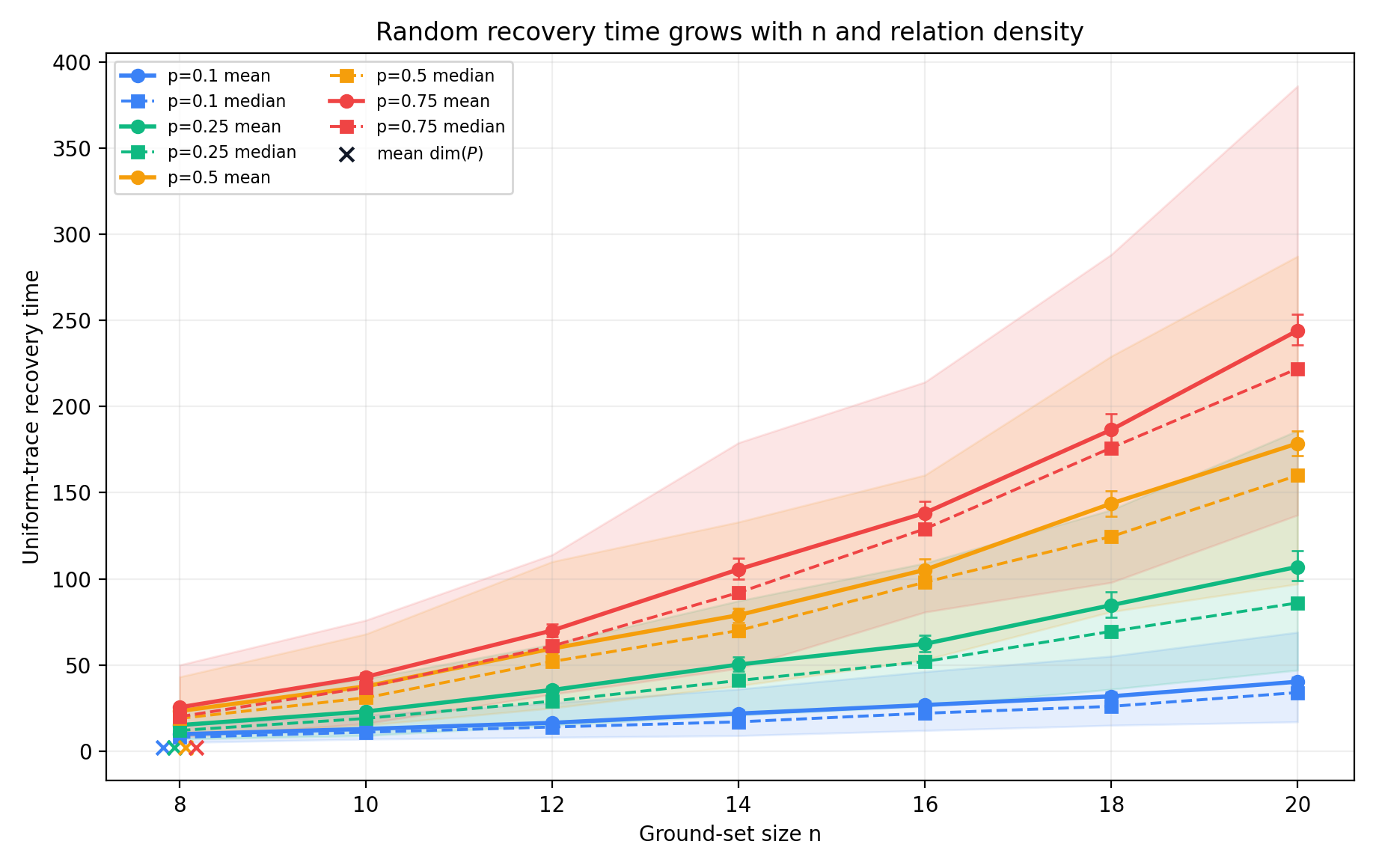
mean traces to recover the true order
mean traces—roughly six times the sparse case
traces, revealing a pronounced rare-event tail
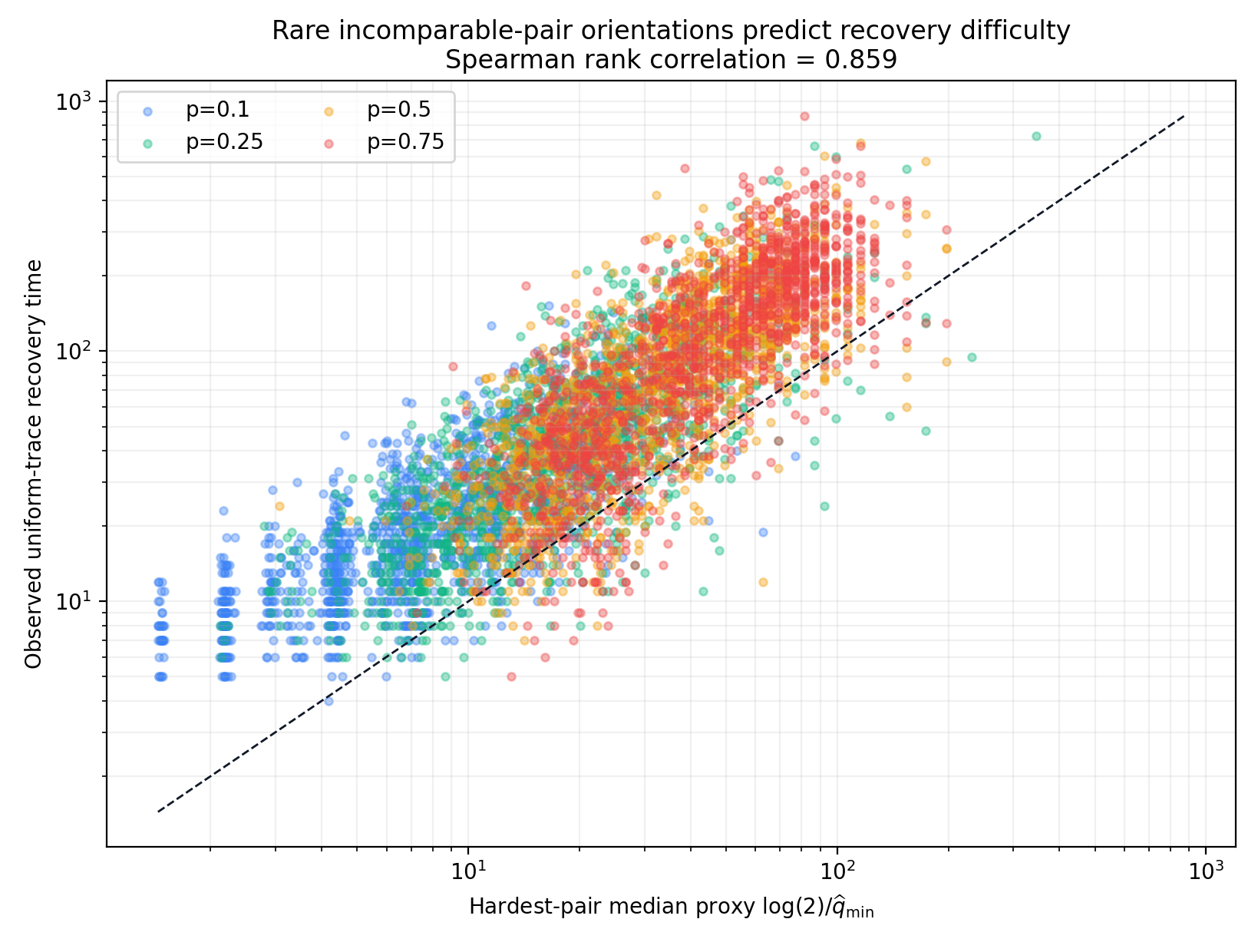
For an incomparable pair x, y, both orders are legal. But legal does not mean equally likely. If one orientation appears only rarely, every other ambiguity can vanish while recovery still waits for that one missing observation.
The experiment rests on exact combinatorial definitions: traces are uniform linear extensions, evidence accumulates by intersection, and recovery is a hitting time.
Keep only pairwise order that all observed traces agree on. The sequence shrinks monotonically toward the true poset.
The first trace count at which every scheduler-imposed comparability has been removed.
Every realized sample path needs at least as many traces as the smallest possible realizer of the poset.
The pipeline avoids approximate trace sampling. Dynamic programming counts every continuation, then uses integer conditional weights to sample each linear extension uniformly.
Draw random height-two posets for seven values of n and four relation densities p.
Draw independent linear extensions exactly uniformly using downset dynamic programming.
Update the agreement order after each trace and record when it first equals the ground truth.
Measure fiber decay, exact small-instance dimension, and hardest-pair orientation rarity.
Tests, deterministic seeds, raw shards, aggregation code, and the final paper are all in the repository.
The paper connects work-span analysis, partial-order semantics, quadratic single-trace ambiguity, a minimax inference barrier, and exact finite-sample recovery bounds.