Compute exact complexity
Minimum-layer enumeration supplies exact formula sizes across the complete four-input universe.
A six-paper research program using exact Boolean synthesis, semantic prediction, analytic envelopes, and frozen prospective tests to learn where mathematical bounds are loose—and why aggressive selection can break their calibration.
The project advances through six linked stages. Exact data establishes the phenomenon; semantic structure explains it; analytic bounds turn it into mathematics; prospective selection reveals where the guarantee still fails.
Minimum-layer enumeration supplies exact formula sizes across the complete four-input universe.
Truth-table invariants record decomposition, certificates, boundary geometry, algebra, and Fourier phase.
Held-out semantic profiles explain 95–97% of minimum-size variation across three gate bases.
Khrapchenko obstruction supplies the lower endpoint; explicit trees, restrictions, and covers supply upper endpoints.
A calibrated headroom model targets cases where a certified construction appears unnecessarily loose.
Top-score selection concentrates rare one-headroom cases and exposes an exact calibration boundary.
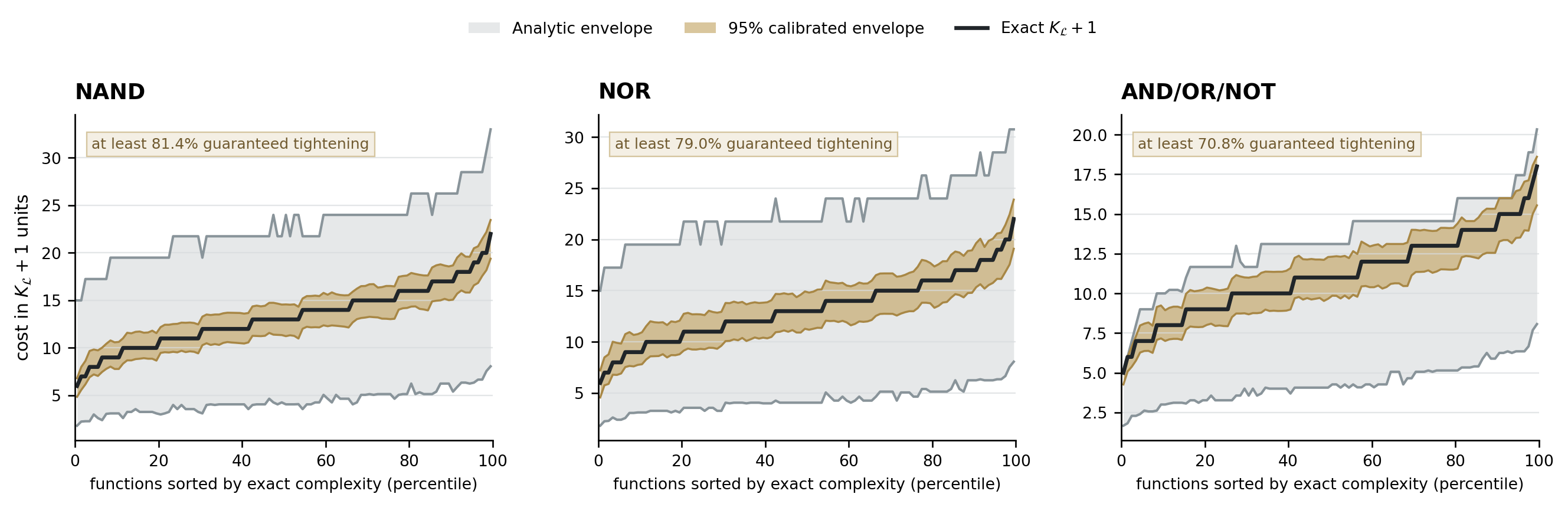
A proved analytic envelope can be intersected with a calibrated prediction interval. The result never widens the theory and inherits the calibration guarantee, while gap normalization certifies a minimum fractional tightening.
When a policy subtracts a learned reduction from a constructive upper bound, validity depends on the available headroom. Top-score selection enriched the one-headroom subgroup and pushed six functions across the exact failure threshold.
Four-input calibration removes most of the uncertainty left by classical bounds. The harder prospective test confirms that semantic ranking finds opportunity, but rejects the claim that the current correction remains safe after top-score selection.
Gray marks the full analytic range; gold shows the gap-normalized 95% envelope; black is exact complexity. Curves summarize equally populated complexity percentiles.
The papers move from prediction to structure, from structure to bounds, and from calibrated refinement to a precisely characterized prospective failure. The negative result narrows the next theorem target rather than erasing the earlier signal.
The six prospective misses are not unrelated errors. They form an exact one-gate-headroom boundary in which construction has nearly solved the instance, global semantic features still predict difficulty, and top-score selection concentrates the dangerous tail.
Open latest paper · PDF“Calibration must follow the query that will actually be made.”When Selection Breaks Calibration
Exact targets, folds, predictions, calibration tables, protocol hashes, failure casebooks, figures, and scripts ship with the repository. Downstream analysis runs locally with no model API. Regenerating the full exact cost-14 layer is a substantial cloud-scale computation.